Signs
House leveling in Austin: when one side settles
In Texas, house leveling is the everyday name for raising the part of a foundation that has gone down and holding it there. It is seldom as simple as jacking up the low corner.
Signs that one side is going down
- Cracks gathered at one end of the house while the other end is clean.
- Floors that run downhill toward the same outside wall in several rooms.
- A widening joint between the house and the driveway, garage apron or patio.
- A chimney leaning away from the wall, with a gap you can see daylight through.
- Porch steps or a stoop that have parted from the brick.
Chimneys and porches need care. They are heavy, and many stand on their own small footing, so one can tip while the house stays put. A gap there may be the chimney's problem alone.
Settling and heaving are opposites that look alike
On clay, a foundation can end up out of level in two ways. An edge can drop when the soil beneath it dries and shrinks. Or a section can rise when the soil beneath it takes on water, from a leak, from poor drainage, or after a big tree is removed and stops drinking.
From inside, both give you sloping floors and cracks. The repair differs. Piers hold up a part that sank. They do nothing for a part that rose, and lifting the rest of the house to match a heaved area can make matters worse. A floor height map, read together with the history of leaks, trees and weather, is how the two are told apart.
What a leveling job generally looks like
Details vary by company and by method. This is the usual order of events on a slab.
Pier points are marked
From the repair plan, along the edge that needs support and sometimes inside.
Holes are dug
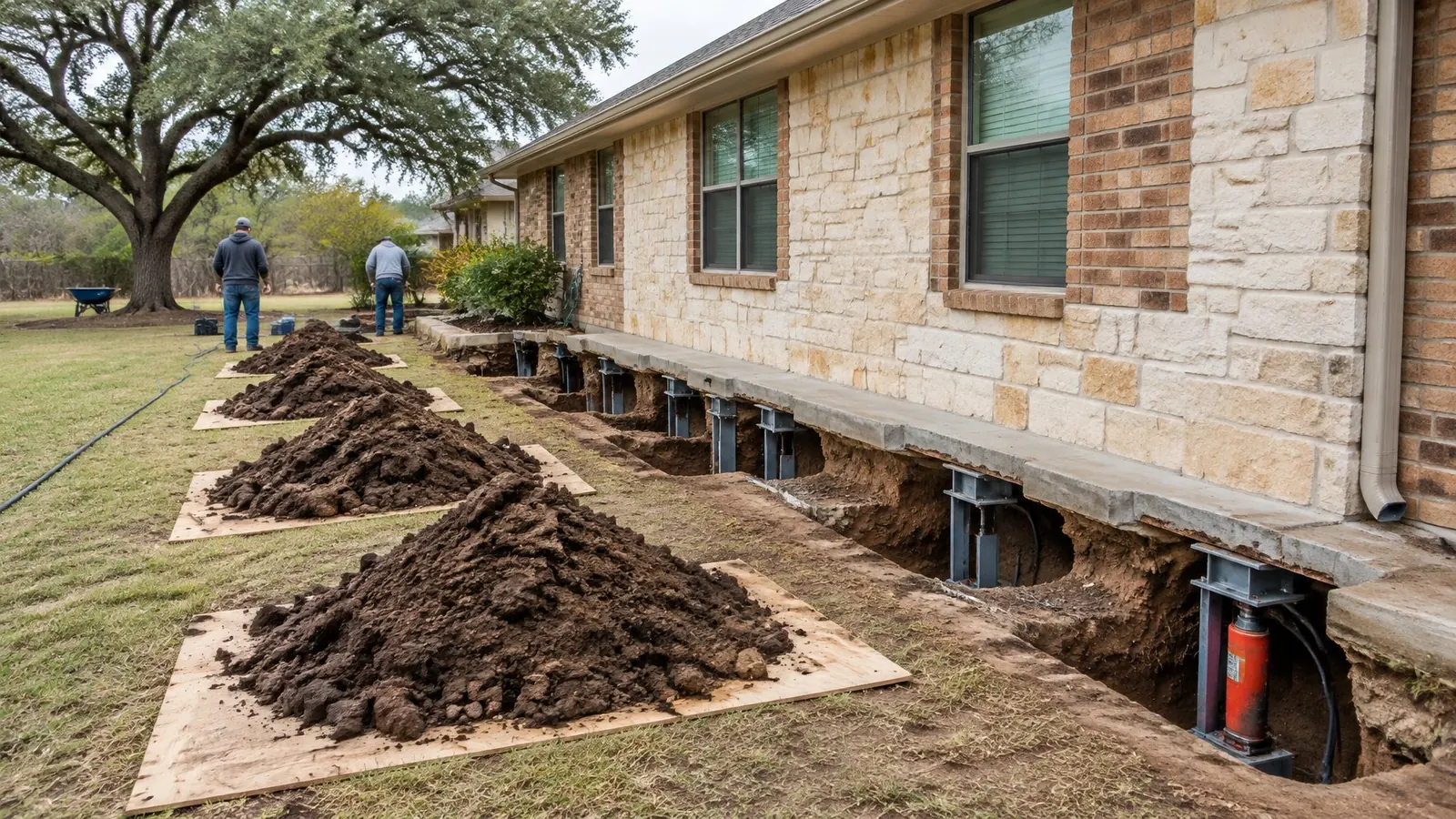
Each about the size of a doormat, beside the slab. Plants and paving in the way are moved.
Piers go in
They are pressed, screwed or drilled down until they reach the resistance the plan calls for.
The slab is raised in stages
Jacks on the piers lift a little at a time while someone inside watches cracks and doors.
Plumbing is tested
Lifting can strain old drain lines under a slab, so a test afterwards is normal.
Holes are filled
Soil goes back and settles over the following weeks.
How level is level
A house that has been out of position for years has adapted to it. Frames, brick and pipes have all shifted a little. Bringing it back the whole way can do more damage than stopping short, so companies aim for as close to the original position as the structure allows. Ask what that means in your case, and expect some doors to need attention and some hairline cracks to appear.
Ask before you agree to a lift
- How many piers, where, and is there a drawing?
- How deep do you expect them to go, and what happens to the price if they go deeper?
- Did an engineer design or review this, and will I get that in writing?
- Is a plumbing test included before and after?
- Who files the permit? Austin's rules are here.
- What does the warranty cover, and who honours it if the company is sold?
Questions about house leveling
Will the house be perfectly level afterwards?
Expect better, not perfect. No honest company promises a dead-flat floor, because the house was probably not dead flat when it was built.
Do we have to move out during the work?
Ask the company. Much slab work is done from outside. Piers inside the house mean cutting through floors, which is more disruptive.
Is leveling a pier and beam house the same job?
No. It is done from the crawl space by adjusting, adding or replacing supports. See the pier and beam page.
Want it looked at?
Phone, say where the house is and what has changed, and you will be speaking with an independent local foundation repair company. It can book a visit to measure the floors and tell you what it finds.
Calls may be recorded. Austin Foundation Repair Help refers callers and repairs nothing itself, as the referral disclosure sets out. Call details are handled under the privacy policy.